

Top 10 Most Cited OSHA Violations 2024
Construction work comes with risks, and while no one expects to get hurt while on the job, workplace injuries can still sometimes happen. These unfortunate incidents don't just delay productivity and increase costs — they also affect real people, their livelihoods, and their families.
The good news? Workplace injuries can be prevented with the right safety measures in place. In this article, LogoSportswear lists the top OSHA violations of 2024, as well as practical tips on how employers and workers can avoid them.
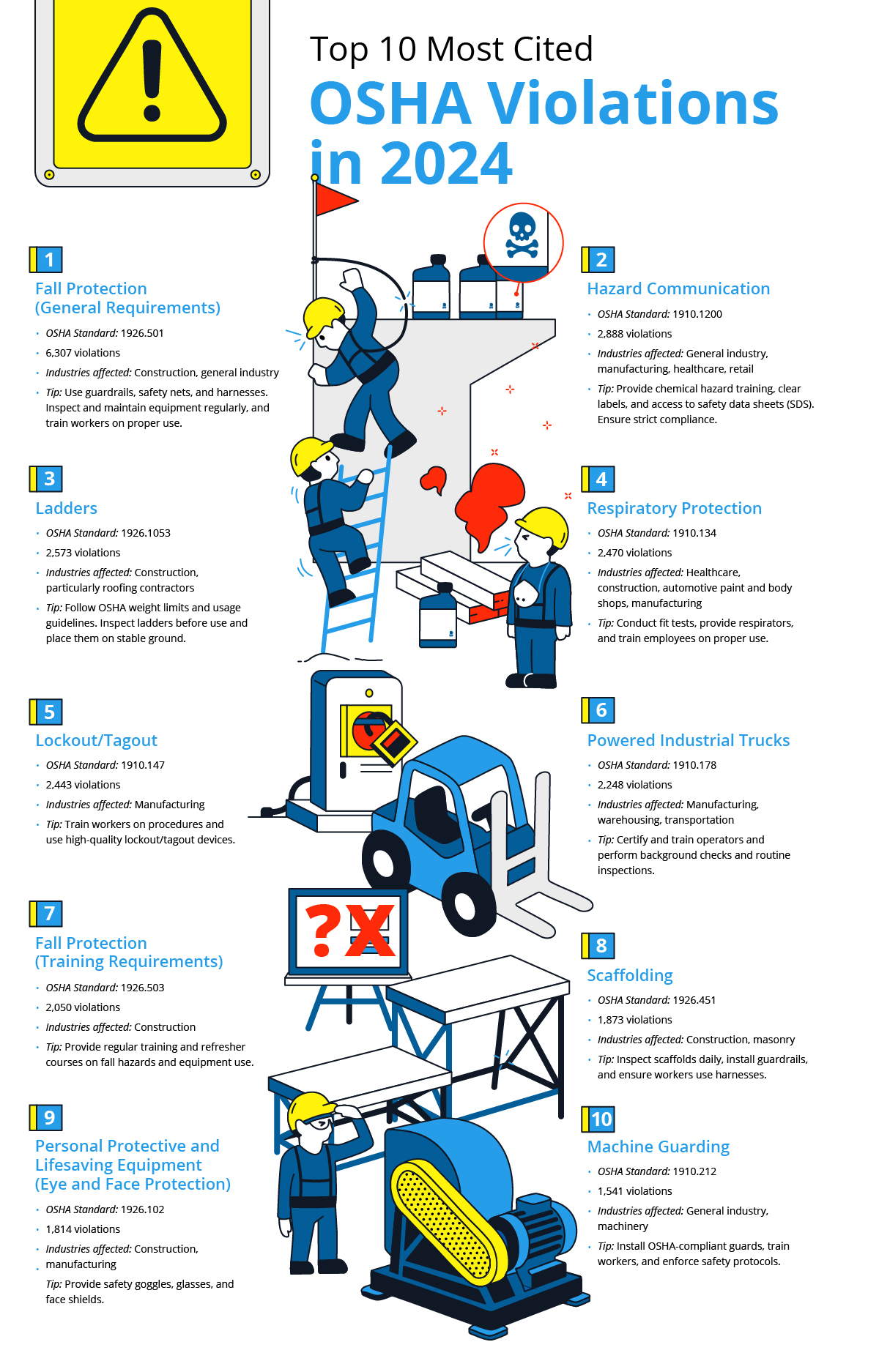
| Violation | No. of Violations | OSHA Standard |
|---|---|---|
| Fall Protection (General Requirements) | 6,307 | 1926.501 |
| Hazard Communication | 2,888 | 1910.1200 |
| Ladders | 2,573 | 1926.1053 |
| Respiratory Protection | 2,470 | 1910.134 |
| Lockout/Tagout | 2,443 | 1910.147 |
| Powered Industrial Trucks | 2,248 | 1910.178 |
| Fall Protection (Training Requirements) | 2,050 | 1926.503 |
| Scaffolding | 1,873 | 1926.451 |
| Personal Protective and Lifesaving Equipment –Eye and Face Protection | 1,814 | 1926.102 |
| Machine Guarding | 1,541 | 1910.212 |
- Fall Protection (General Requirements) - 1926.501 (6,307 violations)
For 14 years in a row, fall protection has remained to be the top workplace violation recorded by OSHA, with 6,307 total citations in 2024. OSHA standard 1926.501 states that employers should provide fall protection measures for employees working at heights of 6 ft. or higher in construction sites, and 4 ft. or higher in the general industry. Proper fall protection includes guardrails, safety nets, or personal fall arrest systems. - Industries affected: Construction, general industry
- Why it's a problem: Falls are the leading cause of fatal workplace injuries. In fact, most accidents happen due to the lack of safety equipment such as guardrails, proper harnesses, or workers not wearing fall protection at all.
- How to prevent this: Make sure to use proper fall protection equipment like guardrails, safety nets, and personal fall arrest systems (harnesses and lanyards). Conduct regular inspections and maintenance, and train workers on how to use them properly.
- Hazard Communication - 1910.1200 (2,888 violations)
OSHA recorded a total of 2,888 hazard communication violations in 2024. OSHA 1910.1200, also known as The OSHA Hazard Communication Standard (HCS), requires employers to make sure that workers are well-informed about hazardous chemicals in the workplace through training programs, labels, and safety data sheets (SDS). - Industries affected: General industry, manufacturing, healthcare, retail
- Why it's a problem: Employees should always be aware of the material that they're handling to stay safe. Incorrect labeling, lack of training on hazardous materials, and inconsistent implementation can cause injuries like chemical burns, respiratory issues, and long-term health issues.
- How to prevent this: Provide proper training about chemical hazards, apply clear labels, and ensure that they have access to various safety data sheets (SDS). It's also important for supervisors and managers to ensure that these safety measures are strictly implemented to avoid mishaps and accidents.
- Ladders – 1926.1053 (2,573 violations)
Ladder use is something that tends to be overlooked on job sites, which is why it ranks third when it comes to OSHA violations. In 2024, OSHA recorded a total of 2,573 violations of ladder use. - Industries affected: Construction, particularly roofing contractors
- Why it's a problem: Falls from ladders can lead to serious injuries. They are often a result of unstable positioning, overreaching, or using ladders that do not adhere to OSHA standards. Most workers use ladders improperly, which increases accident risks.
- How to prevent this: OSHA standard 1926.1053 mandates the safe use of ladders in the workplace, including adhering to the intended weight capacity, using them as how they're designed, maintaining regular inspections, and extending them to at least 3 ft. when in use. Always check ladders before using them. Make sure they're standing on stable ground and that workers do not go above the ladder's weight capacity.
- Respiratory Protection - 1910.134 (2,470 violations)
Coming in fourth with 2,470 violations, respiratory protection is another violation often committed in the workplace. When a business doesn't adhere to OSHA 1910.134, it could mean that the employer has failed to provide proper respiratory protection equipment for employees when exposed to harmful airborne contaminants, perform medical evaluations, fit test respirators, and implement a written respiratory protection program. - Industries affected: Healthcare, construction, automotive paint and body shops, manufacturing
- Why it's a problem: Many workers might not be aware of the effects of long-term exposure to harmful dust, fumes, gases, smoke, and chemicals, which can cause chronic respiratory diseases in the long run.
- How to prevent this: Conduct fit tests, provide respirators to employees, and train workers on proper usage.
- Lockout/Tagout - 1910.147 (2,443 violations)
Lockout/tagout is fifth in the ranking of OSHA violations for 2024, with 2,443 recorded citations. According to OSHA 1910.147, employers must ensure that equipment is properly shut down, lockout and tagout devices are used, and preventive measures are taken to avoid unexpected startups and injuries during maintenance. The standard also highlights that periodic inspections and energy control training programs should be implemented. - Industries affected: Manufacturing
- Why it's a problem: Workers handling machinery can suffer from serious injuries like amputations, electrocutions, and more if the equipment starts unexpectedly.
- How to prevent this: Ensure that employees are properly trained in preventive procedures and use high-quality lockout/tagout devices.
- Powered Industrial Trucks - 1910.178 (2,248 violations)
Forklifts and other industrial vehicles are essential in workplaces that require a lot of heavy lifting, as they make the job more efficient. However, in 2024, OSHA reported 2,248 violations related to powered industrial trucks, reflecting the lack of training and maintenance on properly using them. OSHA 1910.178 requires the safe operation and maintenance of forklifts, and employers should ensure that operators have the training and certification to handle them. - Industries affected: Manufacturing, warehousing, transportation
- Why it's a problem: Forklift accidents lead to collisions and serious injuries due to lack of proper training, thorough maintenance checks, or careless operation.
- How to prevent this: Do a background check on operators and ensure they're certified, and that subsequent training and certification renewal is implemented. Perform regular inspections so the trucks don't have any issues when in use.
- Fall Protection (Training Requirements) - 1926.503 (2,050 violations)
With fall protection in the top spot of most cited OSHA violations, it's not surprising to see many violations related to training requirements. In 2024, OSHA issued 2,050 citations, highlighting a gap in employer-provided training and the need for more focus on training programs for fall hazards in the workplace. OSHA 1926.503 mandates employers to provide training on fall hazards and educate employees on using fall protection equipment properly. - Industries affected: Construction
- Why it's a problem: Lack of training on how to correctly use safety equipment can lead to fall risks in the workplace
- How to prevent this: Conduct refresher courses and regular training sessions so employees stay well-informed on fall hazards and fall protection equipment.
- Scaffolding - 1926.451 (1,873 violations)
Scaffolding is a platform often used to help workers access hard-to-reach areas like roofs, high walls, or building interiors. In 2024, OSHA cited 1,873 violations, which included inadequate fall protection for scaffolds on heights over 10 ft. OSHA 1926.451 regulates the design, construction, weight capacity, and usage of scaffolds, ensuring that they meet the right criteria to keep workers stable and safe. - Industries affected: Construction, masonry
- Why it's a problem:Faulty or overloaded scaffolding can collapse and cause severe injuries to workers.
- How to prevent this:Make daily inspections of scaffoldings, use guardrails, and equip workers with harnesses as required.
- Personal Protective and Lifesaving Equipment – Eye and Face Protection - 1926.102 (1,814 violations)
Working on construction sites exposes you to risks that can damage your eyes or face, yet many workers still lack proper protection. Unfortunately, in 2024, OSHA cited 1,814 violations related to eye and face protection. This means that many employers did not comply with OSHA standard 1926.102, which states that employers are required to provide appropriate eye and face protection when exposed to hazards like flying debris, chemicals, or bright lights in the workplace. - Industries affected: Construction, manufacturing
- Why it's a problem: Eye injuries from chemicals, debris, sparks, and other particles can permanently cause vision loss or burns.
- How to prevent this: Provide goggles, safety glasses, and face shields to workers.
- Machine Guarding - 1910.212 (1,541 violations)
Machines are powerful tools that help get the job done, and if you're often handling machinery, there's always a possibility that you can get injured from its moving parts. Last year, OSHA issued a total of 1,541 machine guarding violations to employers. OSHA standard 1910.212 mandates that employers should provide machine guards to protect workers safe from sparks, moving parts, and flying debris. - Industries affected:General industry, machinery
- Why it's a problem: Workers who operate machinery without proper guarding are at risk of crushing injuries, amputations, and even fatalities.
- How to prevent this:Install and maintain OSHA-compliant machine guards, provide training on safe machine operation and enforce safety protocols.
Conclusion
Every worker deserves a safe workplace that will help them do their job efficiently. By knowing these common OSHA violations and understanding OSHA standards, you can reduce the risk of workplace injuries, improve safety measures, and create a safer work environment for everyone.
